Auditing a classifier with subgroup discovery
A classifier can have good overall performance and poor performance within a describable population. SubROC searches for exceptional ranking performance using labels and prediction scores Siegl et al., 2025.
Train once, then search separate rows
We fit a simple model on part of scikit-learn’s breast-cancer dataset and audit its scores on different rows. Only six measurements are used as descriptors to keep the demonstration small.
from sklearn.datasets import load_breast_cancer
from sklearn.model_selection import train_test_split
from sklearn.pipeline import make_pipeline
from sklearn.preprocessing import StandardScaler
from sklearn.linear_model import LogisticRegression
import matplotlib.pyplot as plt
import pysubgroup as sd
from pysubgroup import visualization as viz

X, y = load_breast_cancer(return_X_y=True, as_frame=True)
X = X.iloc[:, :6]
X_train, X_audit, y_train, y_audit = train_test_split(
    X, y, test_size=0.5, stratify=y, random_state=13)
model = make_pipeline(StandardScaler(), LogisticRegression(C=0.1, max_iter=1000))
model.fit(X_train, y_train)
data = X_audit.assign(label=y_audit, score=model.predict_proba(X_audit)[:, 1])
target = sd.SoftClassifierTarget().fit(data, "label", "score", positive_value=1)
conditions = sd.generate_conditions(X_audit, n_bins=3)
qf = sd.ROCAUCQF(subgroup_class_balance_weight=1, subgroup_size_weight=0.5)
task = sd.SubgroupDiscoveryTask(data, target, conditions, qf,
    depth=2, result_set_size=4, min_quality=0,
    filters=[sd.MinSizeFilter(35), sd.MinPositivesFilter(5)])
results = sd.DFS().execute(task)
sd.to_dataframe(results, data, target, ["size", "positives", "target_share", "roc_auc"])positive_value defines which label the score ranks upward. Check its meaning:
the loader encodes benign as 1. Reversing the score-label pairing would reverse
the performance interpretation. Both label and score columns are target
attributes and must stay outside subgroup descriptions.
What the measures detect
| Measure | Positive quality means |
|---|---|
ROCAUCQF | Subgroup ROC AUC is lower than dataset ROC AUC |
PRAUCQF | Subgroup precision–recall area is lower |
ARLQF | Subgroup average ranking loss is higher |
ROC AUC is the probability of a positive scoring above a negative, counting ties as half. It requires both labels. PR area here uses trapezoidal integration, including the initial precision of one; it is not scikit-learn’s average precision. ARL is the average number of negatives ranked above a positive, so it depends on the number of negatives as well as their ordering.
For ROC AUC, the weighted score is
where is the minority/majority class-count ratio. The constructor names the
balance weight first () and size weight second (); keyword
arguments make this unambiguous. A subgroup with an undefined metric scores
-inf and is not reported. MinPositivesFilter alone does not ensure negatives.
Read the curves and sample sizes
if results:
    viz.plot_performance_curves(results, data, target, curve="roc")
    plt.show()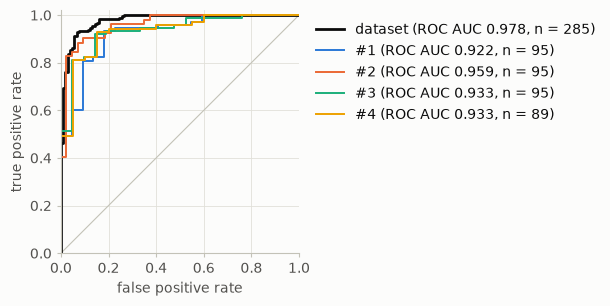
The dataset curve provides the reference; subgroup curves show local ranking. Their shapes may be jagged because some groups contain few positive-negative pairs. A lower AUC does not automatically imply lower accuracy at the operating threshold, worse calibration, or a causal explanation for performance loss. Those are different audit questions.
Choice of weights affects discovery and pruning
Without weights, a tiny group with a single reversed pair can be very extreme. Size and balance weights favor effects supported by more observations and both classes. The implemented bound is useful without weighting or with . Unsupported weight combinations can still be scored, but their optimistic estimate may be infinite and provide no pruning.
Exploration is not confirmation
These audit rows were not used to fit the classifier, but they were used to choose the subgroup descriptions. Their subgroup performance estimates are still selected. The validation chapter introduces independent subgroup validation, and the complete audit workflow keeps training, discovery, and validation separate.
Experiment. Repeat with ROCAUCQF() and with PRAUCQF(1, 0.5). Are the
same descriptions preferred? Inspect class balance and both curves before
interpreting disagreement as a contradiction.
- Siegl, T., Coşkun, K., Hiller, B. C., Mirzaei, A., Lemmerich, F., & Becker, M. (2025). SubROC: AUC-Based Discovery of Exceptional Subgroup Performance for Binary Classifiers. 10.48550/arXiv.2505.11283